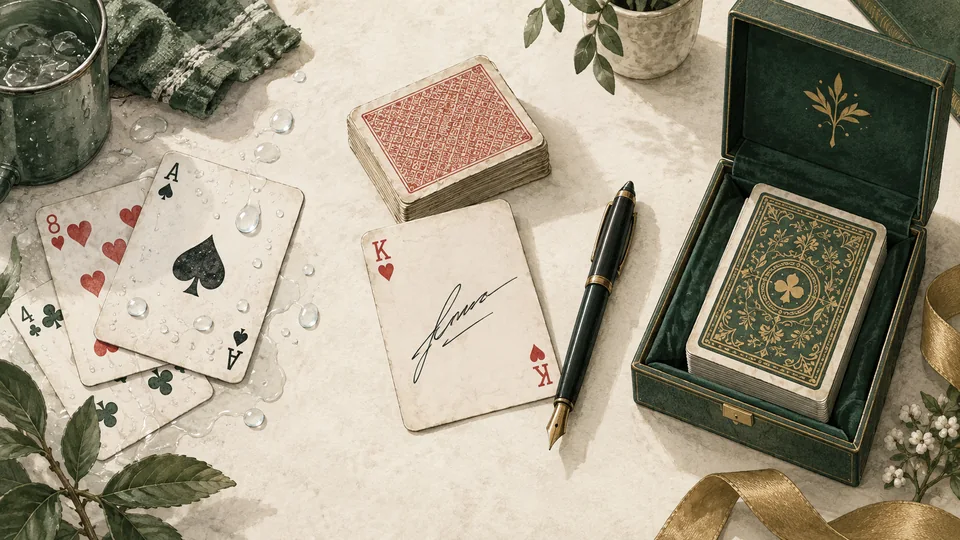
A longer-lasting deck of cards sounds like an obvious improvement. But consider a magician whose routine ends with a spectator keeping a signed card. Extra durability contributes little to that card’s useful life in the performance. Reliable handling and affordable replacement matter much more.
Playing cards make an interesting product case because seemingly straightforward improvements can change value depending on who uses them. A different material, a more elaborate design or a higher price can make a deck more suitable for one situation and less suitable for another.
Even a product as familiar as a deck of cards contains several competing definitions of quality.
From wider access to more specialised uses
There is a long history behind that variety. The V&A describes how woodblock printing allowed cards to be produced in sheets, making them accessible to a wider audience than individually painted cards. Manufacturing changed who could afford to play. V&A: Recreating early-Renaissance playing cards
Today, the choices extend well beyond making the same object more cheaply. Waterproof decks, specialist performance decks and elaborate collectible editions address different reasons for buying cards. Looking at those differences reveals something useful about requirements: we can agree that a feature is “better” while quietly imagining different uses.
Materials: durability can come with a trade-off
Consider material choice. For someone taking cards to a swimming pool, water resistance has an obvious purpose. Bicycle explicitly markets its waterproof deck for pool parties and beach trips, with washable plastic cards and a protective case. Bicycle Waterproof
Now put that deck in the hands of someone learning cardistry, the art of manipulating cards through fans, cuts and other visual movements. The requirements change. Cards need to spread evenly, bend predictably and slide against each other in a controlled way. In its beginner guide, 52Kards recommends paper cards and cautions that handling learned on plastic does not always transfer cleanly to paper. 52Kards: Beginner’s guide to cardistry
The material decision now includes compatibility with a skill the user is developing. Improving resistance to water would be a poor trade if it compromised the handling that person wanted to practise.
That makes “more durable” an incomplete requirement. Its value depends on what durability costs in money, feel or suitability for the task.
Replacement cost: when cards become consumables
Replacement introduces another dimension. Vanishing Inc. recommends inexpensive, good-quality decks for beginners because learning cardistry involves dropping and damaging cards. It also warns against poorly handling budget decks. The useful balance is adequate performance at a replacement cost the learner can sustain. Vanishing Inc.: Getting started in cardistry
The magician example makes this distinction particularly clear. If a routine requires a card to be signed and given away, that card becomes a consumable input. Assuming two decks both meet the routine’s handling requirements, paying more for longevity brings little benefit to that use.
The same person could reasonably choose a different deck for another routine. This is why a segment such as “professional magician” still leaves important questions unanswered. Knowing the customer’s occupation does not tell us whether the next card will be manipulated, displayed, folded or handed to someone as a souvenir.
Casinos: useful life depends on trust
Casinos add a further complication: a card’s useful life can end while it remains physically capable of being shuffled and dealt.
A scratch or mark can make a card recognisable from its back, creating an advantage for someone who notices it. A deck may therefore need replacing even when the cards still handle well. Inspection and controlled replacement become part of keeping the game trustworthy.
Here, the relevant requirement includes maintaining confidence in the game. Physical endurance is only one part of fitness for use. A material improvement that helps prevent identifiable marks could matter considerably; extra resistance to an unrelated kind of wear might contribute much less.
For a product manager, that distinction changes the investigation. Understanding why a product gets replaced is more informative than measuring how long its materials can survive.
Premium design: what the buyer is paying for
Appearance creates another set of trade-offs. Theory11 presents custom artwork, foil packaging and embossing as central parts of its premium offering. Those are visible elements of the proposition, although they do not establish superior handling for every application. Theory11 playing cards
For a buyer choosing a gift or an object to display, presentation can be part of the desired outcome. Evaluating that purchase only by the number of games the deck survives would miss much of its purpose.
And I haven’t even gone into the collectors’ end of the market: limited editions, decks associated with particular designers, and releases listed at more than $200 for a single deck. The gilded Cherry Casino Monte Carlo Black and Gold edition, for example, is limited to 144 numbered decks. Vanishing Inc. lists one deck with its acrylic display case at $250, although it was out of stock when checked. These products speak to a specific community of card enthusiasts, for whom owning a particular edition, following a designer’s work or completing a collection can be the reason to buy.
Design can also contribute directly to performance. Cardistry decks use patterns and colours to accentuate movement. An attribute that adds little to an ordinary card game can become useful when watching the cards move is the point.
Prioritisation: identify what makes the product inadequate
These examples suggest a more precise way to think about a product improvement: identify the event that makes the current product inadequate.
For the outdoor player, that event might be water damage. For the cardist, inconsistent handling. For the magician giving cards away, depletion. For the casino, a threat to game integrity. Each leads toward a different requirement and a different reason to spend money.
Suppose a card manufacturer were choosing between a tougher material, a more consistent finish and more elaborate artwork. A broad ambition to make a “premium deck” would provide little direction. A clear account of the intended use would make the trade-offs much easier to assess.
Playing cards are useful to think with because the object stays familiar while the purchase changes meaning. Before prioritising an improvement, it helps to understand what ends the product’s usefulness for the customer. That is where a feature earns its place.
Summary overview: decks, customers, jobs and prices
On smaller screens, scroll horizontally to compare all five columns.
| Deck type | Customer / context | Job to be done | Main buying criteria | Example price per deck (USD) |
|---|---|---|---|---|
| Standard paper | Beginner cardist | Practise movements repeatedly | Reliable handling and affordable replacement | $3.95: Bicycle Rider Back, blue52Kards |
| Standard paper | Magician giving away signed cards | Perform a routine and leave a souvenir | Suitable handling, availability and replacement cost | $3.95: Bicycle Rider Back, blue52Kards; suitability depends on the routine |
| Waterproof plastic | Outdoor player | Keep playing around water and sand | Water resistance, washability and protective storage | $8.49: Bicycle WaterproofGamers Guild AZ; sale price, $9.99 listed regular price |
| Specialist cardistry | Cardist performing or filming | Create controlled, visually striking movements | Handling, patterns and colour | $24.95: Virtuoso Fall/Winter 201752Kards; listed price, sold out when checked |
| Cards used in casino play | Casino operator | Run games while protecting their integrity | Freedom from identifying marks, inspection and controlled replacement | Comparable procurement price not verifiedConsumer retail prices would not establish the casino’s purchase cost |
| Premium illustrated | Collector or gift buyer | Collect, display or give something meaningful | Artwork, theme and packaging | $12.95: MedallionsTheory11 |
| Limited-edition collectible | Dedicated card collector | Own a particular edition or complete a collection | Rarity, design, creator, edition and condition | $250: Cherry Casino Monte Carlo Black and Gold, gilded editionVanishing Inc.; 144 numbered decks, acrylic case included; out of stock when checked |
These examples do not establish category price ranges, completed sale prices or measured willingness to pay. Prices and availability can change.